
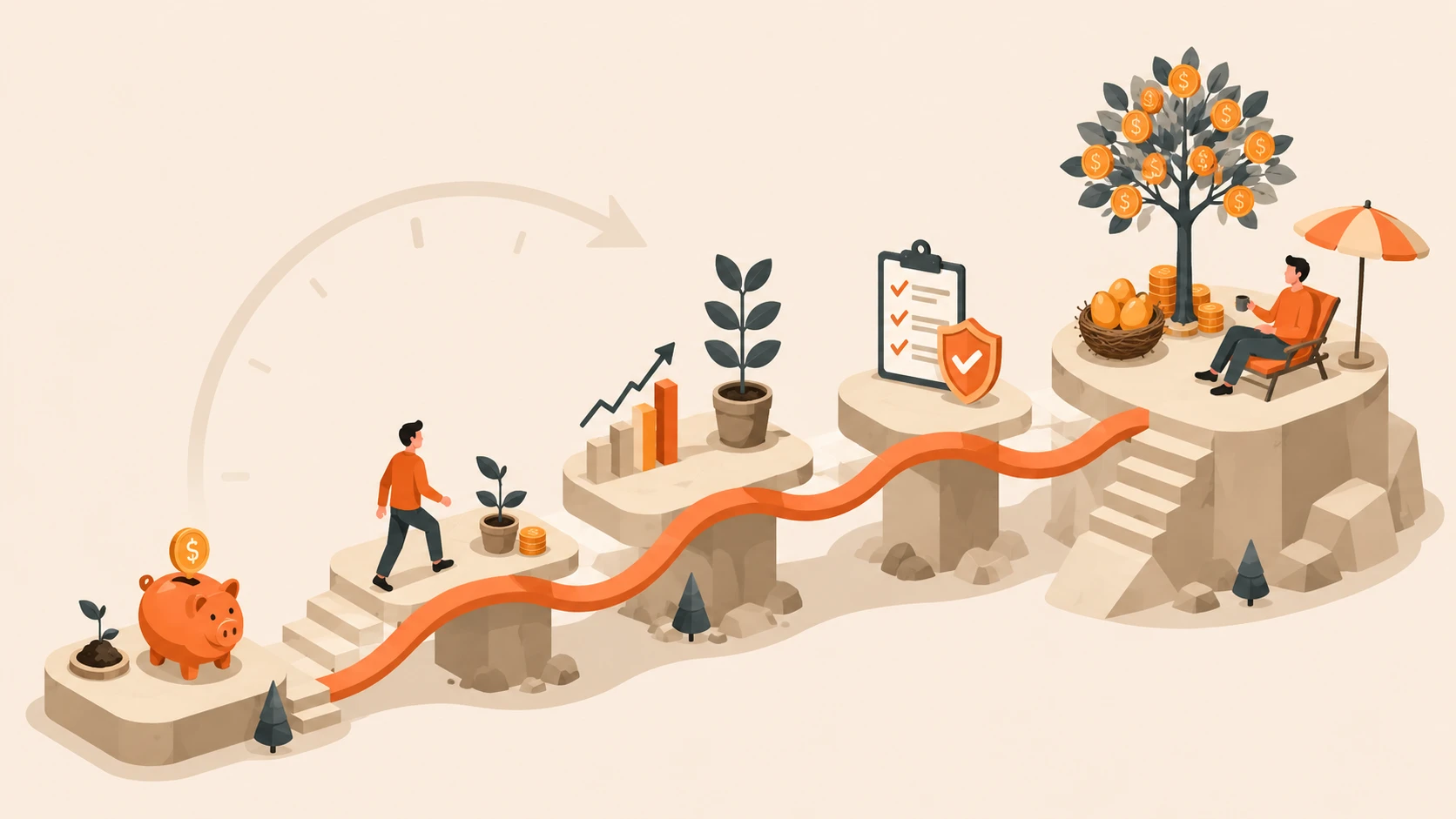
Most retirement advice treats the journey like one long, undifferentiated slog: save more, invest wisely, hope for the best. But the truth is, what you should focus on changes dramatically with each decade. The mistakes that matter at 35 are completely different from the ones that matter at 55.
Here’s the decade-by-decade playbook. No country-specific jargon, just the financial mechanics that work everywhere.
Your 20s: build the foundation
Your 20s are the time to build lasting saving habits. The amounts are small, but the muscle memory of saving automatically is worth more than any single investment decision you’ll make later.[1]
Start with three moves:
- Automate a savings contribution, even 5 – 10% of income, into whatever tax-advantaged retirement account your employer or government offers
- Build an emergency fund that covers 3 – 6 months of expenses, so you never raid your retirement savings
- Learn the basics of low-cost, diversified investing. You don’t need to pick stocks, you need broad-market index funds
The biggest risk in your 20s is waiting to start.
Your 30s: time is everything
Your 30s are the highest-leverage decade for retirement, full stop. Thanks to compounding, a dollar invested at 30 grows to roughly four times what a dollar invested at 50 becomes, assuming ~7% real returns.[2] You don’t need the perfect portfolio. You just need to be saving enough, early enough.
The target: 15 – 20% of gross income, including any employer match or mandatory pension contribution. If that sounds aggressive, start at whatever you can and bump it by 1 – 2% each year. Most people don’t notice the incremental changes.
The priority order:
- Capture the full employer match on your workplace retirement plan (it’s free money, so don’t leave it)
- Max out any tax-free or tax-advantaged accounts available to you
- Increase contributions beyond the minimum each time your income rises
The biggest threat: Lifestyle inflation. Every raise that goes straight to a nicer apartment or a new car is a raise your future self never sees. Keep your savings rate growing with your income, not just your spending.
What matters most in your 30s is the same thing that matters most in every decade: keep the savings rate moving upward and let compounding do the work.
Your 40s: stress-test the plan
By 40, a common benchmark is 3× your annual salary saved for retirement. If you’re there, great. Shift your focus from “save more” to “save smarter.” If you’re behind, this is the last decade where aggressive saving still gets a meaningful compounding boost.
This is the decade to start asking uncomfortable “what if” questions:
- What if the market drops 30% the year I plan to retire?
- What if I lose my job at 55 and can’t find comparable work?
- What if my healthcare costs double in retirement?
- What if I need to support aging parents or adult children?
If your plan only works in the sunny scenario, it is too fragile. The fixes are easier at 42 than at 58. Run the projections now with conservative assumptions, and you’ll thank yourself later.
Contribute to both tax-deferred and tax-free accounts in your 40s, if your jurisdiction offers both. This creates withdrawal flexibility later: you can pull from whichever bucket minimizes your tax bill in any given year. Future you will appreciate the optionality.
Your 50s: the plan gets real
This is where retirement planning stops being abstract. Government pension estimates start to mean something. Workplace pension calculations, if applicable, crystallize. Your portfolio is big enough that allocation decisions have real dollar consequences.
The main task now is mapping your income transition: which money comes from where, and when? When does your government pension start? How do you bridge the gap between your last paycheck and the first guaranteed income stream?
Catch-up provisions typically become available around age 50 in most jurisdictions, with higher contribution limits for retirement accounts. If you can swing it, those extra contributions compound tax-free for 15+ years.
The fine-tuning available in your 50s (strategic account conversions in low-income years, account consolidation, withdrawal sequencing optimization) can be worth as much as years of extra saving earlier.[3] This is where the details pay off.
Your 60s: execute, don’t freeze
The five years before and after retirement are the most financially consequential of the whole process. This is when sequence-of-returns risk peaks, which is a fancy way of saying “a big market drop right when you start withdrawing can permanently damage your retirement.”
Delaying government pension benefits, even by a few years, often increases your lifetime income by 30 – 80%. For most people, this is the largest financial optimization available, and it’s just a timing decision.
Compare what retirement looks like at different claiming ages. The difference in lifetime income is often hundreds of thousands of dollars. Combine that with a smart first-five-years withdrawal strategy (lean on taxable accounts first, let tax-deferred accounts keep growing, consider strategic conversions to tax-free accounts) and you can meaningfully increase both your income and your portfolio’s longevity.
- Check pension estimates at your earliest, standard, and deferred eligibility ages. Find the claiming age that maximizes lifetime benefits for your health and situation
- Build a withdrawal sequence for the first 5 years that avoids selling equities in a downturn
- Look for conversion windows between retirement and mandatory distribution ages to reduce future tax burdens
- Plan for annual reviews. The first few years need more adjustments than any other period
Many people freeze at this stage, overwhelmed by the irreversibility of it all. But inaction is itself a decision, and often a costly one. Set a review cadence, make informed adjustments, and trust the decades of groundwork you’ve already laid.
The principles that hold across every decade
Regardless of where you are in the timeline, four rules apply everywhere:
- Save automatically. Willpower is unreliable. Automate your contributions so the decision is made once, not every paycheck.
- Keep costs low. Investment fees compound in reverse. A 1% annual fee can eat 25 – 30% of your returns over 30 years.
- Diversify across tax treatments. Having money in tax-deferred, tax-free, and taxable accounts gives you extraordinary flexibility later.
- Don’t try to time the market. Time in the market beats timing the market, decade after decade.[4]