
“My FIRE number is €1 million.” That statement gives you a starting point, not a plan. You still need the age when you want to stop working, the spending you expect in retirement, the date your mortgage ends, the pension income you expect, and the taxes on your withdrawals.
Two households can start with the same balance and face very different cash flows for the next 40 years.
Start with the 25× shortcut
The familiar calculation comes from the reciprocal of a 4% withdrawal rate:
If your portfolio must provide €40,000 in the first retirement year, the shortcut gives you a €1 million target.
William Bengen’s 1994 research tested a 4% first-year withdrawal followed by inflation adjustments against historical US stock, bond, and inflation data. His sample supported at least 30 years across the periods he studied.[1] Cooley, Hubbard, and Walz tested a wider range of rates and portfolio mixes in 1998, covering 15- to 30-year periods while excluding taxes and transaction costs.[2]
The shortcut earns its place because it connects annual spending to a clear capital target. It also compresses a long retirement into one number, so use it for orientation.
Put the number on a timeline
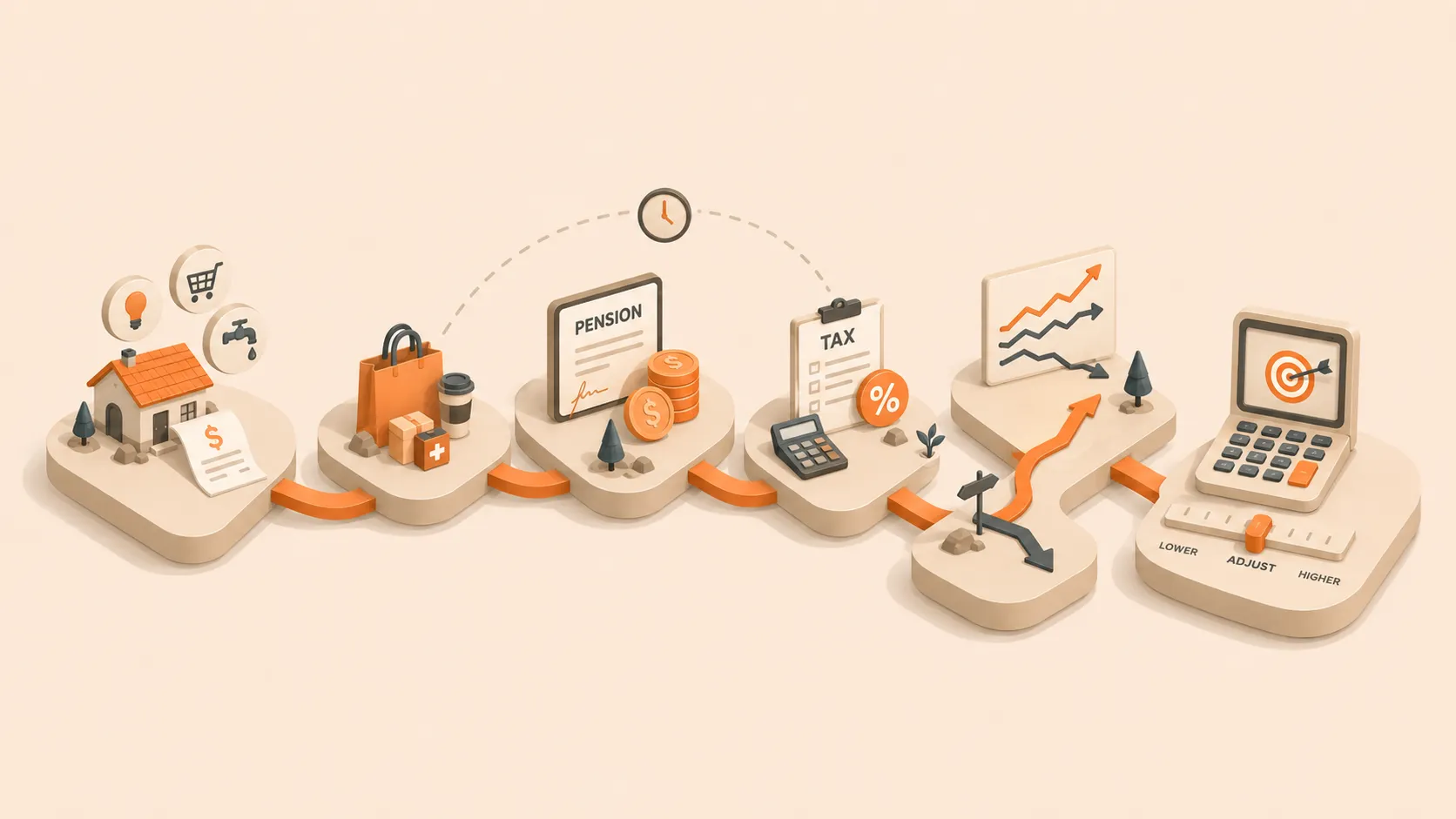
Your spending will change. A mortgage can end, travel can increase during the first retirement decade, children can leave home, and large costs can arrive in specific years. A bank statement from last year gives every future year the same shape. A projection lets each period have its own spending level.
Taxes create another gap. If you need €40,000 after tax and assume a 15% effective tax rate, your portfolio would need to provide about €47,059 before tax.
Irregular costs deserve dates too. A €12,000 renovation every 12 years can become a €1,000 annual reserve, or you can place the full cost in the year you expect to pay it. The second approach shows how the expense interacts with a market decline.
Pensions and other income reduce the portfolio gap, but only after they begin. Ana might need €40,000 from her portfolio between ages 50 and 59, then €10,000 after a €18,000 pension begins at 67 and her mortgage ends. Multiplying €10,000 by 25 ignores the 17-year bridge. Multiplying €40,000 by 25 ignores the later pension.
Choose either real euros throughout or nominal euros with inflation applied to future cash flows. Do not mix both methods.
Test the return sequence
A long-run average return does not arrive in a smooth line. Markets can fall during the first retirement years and recover later. Withdrawals make the order matter because assets sold after a fall cannot participate in the recovery.
Test a poor first five years separately. A plan that survives a smooth 5% return path can fail after an early drawdown even when the long-run average ends near 5%.
Ask what happens after a 20% fall in year one, a 40% fall in year one, or two weak years at the start. The useful answer is the action you would take, not the scenario that proves you can retire.
Build the target in six checks
- Estimate retirement spending in today’s money and separate recurring costs from large irregular costs.
- Add mortgage end dates, rent changes, planned moves, or other housing shifts.
- Add pensions, benefits, rental income, and later work in the years they begin.
- Model taxes on the income and withdrawals your accounts can produce.
- Choose a horizon that fits your age instead of borrowing a 30-year horizon by habit.
- Compare an early retirement date with later dates and stress-test bad early returns.
Fignis can help you compare those assumptions without forcing one forecast to carry the whole decision. Build a base case, change the retirement date or pension timing, and compare the portfolio paths.
Use €1 million if it helps you track progress, but keep the assumptions beside it. Write down the retirement age, spending basis, withdrawal method, pension dates, tax treatment, and return scenarios. Recalculate when any of them changes.
Build the wider FI planConnect your target with savings, portfolio growth, and the years between financial independence and later retirement income. Examine the withdrawal-rate benchmarkSee how 3%, 4%, and 5% starting rates change the capital target and the risks you take.